
Blog
Blog
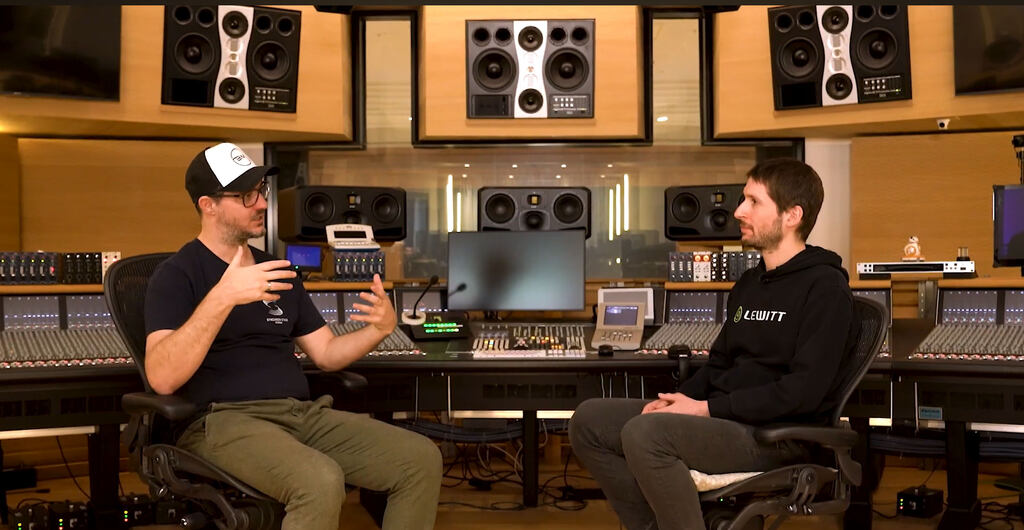
How is it possible that some of the most celebrated film scores in the world get recorded not in Hollywood, but in Vienna? That is the question I walked in with when I arrived at Synchron Stage Vienna to meet Bernd Mazagg, the facility's Technical Director and Senior Audio Engineer.
Stage A, the main recording room, is a cavernous space that spans 480 square meters, with ceilings rising between 10.5 and 12 meters above the floor. Walk in for the first time, and the first things that strike you are the scale and the quiet. Over the course of a few hours, Bernd walked me through the operation: the acoustic design, the recording workflow, the microphone setup, and the in-house musical ensemble that keeps productions coming back.
Watch the video below!
The building dates to the 1940s, when it was purpose-built for film score recording. That founding purpose shaped everything about the design and it shows up most clearly in one detail Bernd mentioned early in our conversation.
"The whole acoustic design was built to have a whole orchestra in one microphone."
Think about what that requires. A room that can fit a full orchestra, strings, brass, woodwinds, percussion, sometimes a choir, and still produce a balanced, coherent sound from a single stereo or mono capture point. No muddy low end, no harsh reflections piling up in the upper frequencies, nothing overpowering anything else.
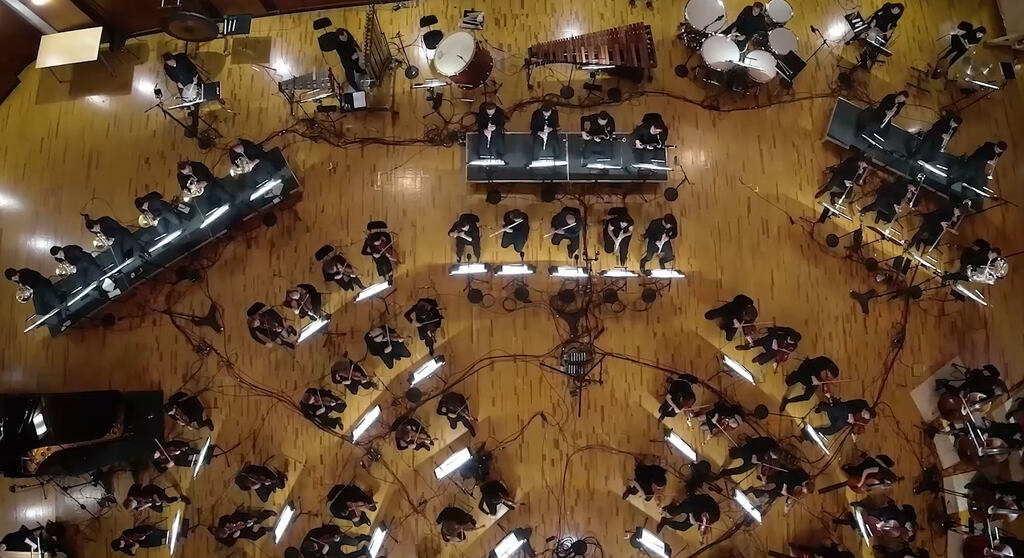
The geometry of Stage A is a big part of how that balance is achieved. Neither the walls nor the ceiling runs perfectly parallel to each other or to the floor - by design. When two parallel surfaces face each other in a room, certain frequencies build up between them - what acousticians call standing waves - producing an uneven response where some notes resonate unnaturally, and others disappear due to frequency cancellation. Breaking the parallel geometry disrupts that buildup. "Even the low frequencies are nicely balanced to the high frequencies," Bernd explained, "so without masking anything, you have a nice, diffused sound."
It is a deceptively simple idea. But in practice, it takes precise acoustic planning to execute, and the result is an incredible sounding room which has been in active use for film score recording for more than 80 years.
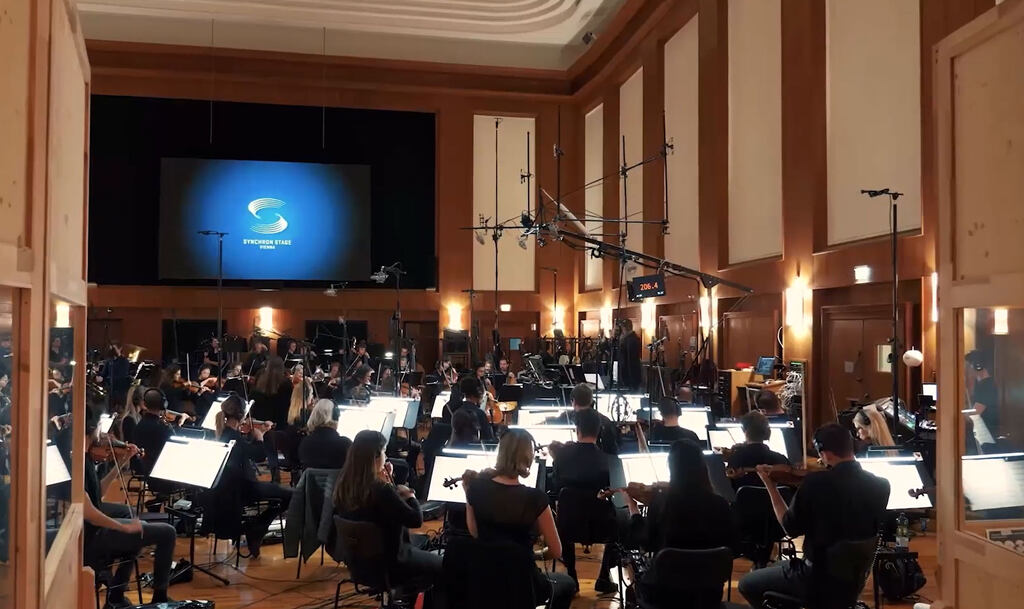
Before an orchestra ever plays a note in Stage A, an enormous amount of work has already taken place in preparation for tracking day.
Writing and orchestrating a film score can take a year or two, Bernd told me, "depending on the project." Many composers work at the piano, sketching harmonic and melodic material, then pass their ideas to an orchestrator. The orchestrator's job is to take those sketches and assign every melodic idea to a specific instrument and section: what the violins play, what the trumpets play, where the woodwinds come in. The result is a full set of charts for every musician in the orchestra, so everyone is prepared for the recording session.
When that music arrives at Synchron Stage Vienna, the technical preparation begins. "We receive all the music," Bernd explained, the sheets for the musicians, the scores, and the Pro Tools session from the score mixer. Before the recording day, Bernd's team works with the score mixer on the session plan: the floor layout, which microphones go where, whether any positions need adjusting for a specific project.
Then the musicians arrive. What happens next surprised me the first time Bernd described it. "Sometimes they just get the sheet music one hour before, or they just see the score when they're coming into the room." They sit down and do a quick microphone check and then they record music they are reading for the first time.
Most sessions also include a click track that the musicians hear in their headphones. This is important because film scoring requires music to hit specific moments in the picture, a scene change, a line of dialogue, a climax, etc. Time code synchronizes the recorded music to the edit, and the click track is how musicians can follow to precise cues that follow the time code.
I asked Bernd what his favorite moment in a recording day is: "I think it's always the first cue - because right after the first cue, you sit there and say, 'Oh, sounding great, this will be an easy, good day for everyone.' I think that's the most important moment for me."
"Which microphone you put on which instrument - that's the most important sound decision you make."
Bernd said this while we stood in Stage A, looking at the array of microphones positioned around the room. If you have talented musicians in a great sounding room, the next obvious variable to pay attention to is the microphones capturing them.
A full orchestral setup at Synchron Stage Vienna uses multiple layers of microphones, each doing a distinct job in capturing the overall picture.
Above the conductor's position hangs the DECA tree, Synchron Stage Vienna's main room microphone system, the foundation of every orchestral recording in Stage A.
On either side of the main array are the Outriggers, and this is where LEWITT comes in.
Bernd uses two LEWITT LCT 1040s as outriggers in Stage A. "Just to have an even wider orchestral sound," he told me. Flanking the main array, the outriggers extend the stereo image beyond the edges of the orchestra, capturing its full width across the room.
Beyond the outriggers, positioned close to the ceiling at roughly seven meters, are the high outriggers. These are placed high deliberately: at that height and distance from the orchestra, they pick up more of the room itself, the ambience, the decay, the sense of space that makes a large orchestral recording feel like it was recorded in a large room.
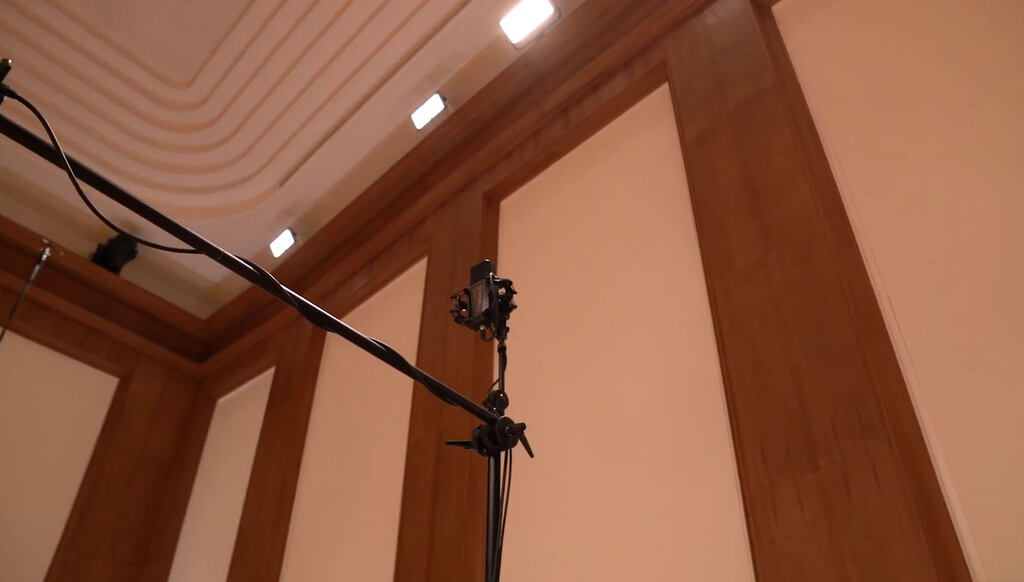
For a setup spread across a room this large, the ability to adjust a microphone from the mix position without sending someone across the floor becomes practically important. The LCT 1040's remote control detaches from the power supply unit and can be connected via a standard 3-pin XLR cable - which means Bernd can fine-tune the polar pattern from the sweet spot, once the mics are in position.
Orchestral recording presents one specific technical challenge that does not come up in most other recording contexts: capturing extremely quiet details.
Pianissimo strings. A solo woodwind. A single struck note hanging in the room before it fades. In those moments, the microphone's own noise floor can become audible. Every microphone has a noise floor and when you're capturing such wide dynamics, this spec becomes more important than ever.
The LEWITT LCT 540 S was designed around this problem. Its self-noise is 4 dB(A), a figure below the threshold of human hearing. You will not hear the microphone's self-noise even when you crank the preamp gain to hear those quiet moments.
Bernd's first experience with the LCT 540 S immediately made an impression on him. "LEWITT was not on my table," he told me, describing the period before he first tried the microphones on an orchestra. What followed surprised him. "With the 540 and the 1040, I was very surprised how much Pro you are. When I had you the first time on an orchestra, I was really surprised and said: 'Hey, wow, that's really cool.'"
Most modern recording facilities are booked by different labels, producers or musicians per project and don't typically supply session musicians. Synchron Stage Vienna works differently.
The facility has a contractor managing a core pool of 700 to 800 musicians, with an extended network of around 2,000. When a production needs to assemble a 100-piece orchestra on short notice, that pool makes it possible. And the musicians in it are film scoring specialists - players who are trained to sight-read complex parts and perform them accurately on the first or second take on music they have never seen before.
What makes Synchron Stage Vienna unusual is the scope of what comes with a single booking. "You can call and say you need a 100-piece orchestra, and you get everything from our side," Bernd explained. "You get the conductor, the Pro Tools engineer, the audio engineer, the music prep team, and many instruments as well."
For productions with tighter budgets or shorter timelines, the facility also offers a hybrid option. Synchron Stage Vienna has sampled virtually its entire instrument collection inside Stage A itself - which means composers can combine live-recorded sections with library elements that were captured in the same acoustic space, with the same character. Real strings recorded last week can sit alongside sampled brass from the same hall, recorded last year, and the blend is coherent because the room is identical.
Stage A is where the recording happens, but below the stages you'll find an extensive collection of unique orchestral instruments available for use.
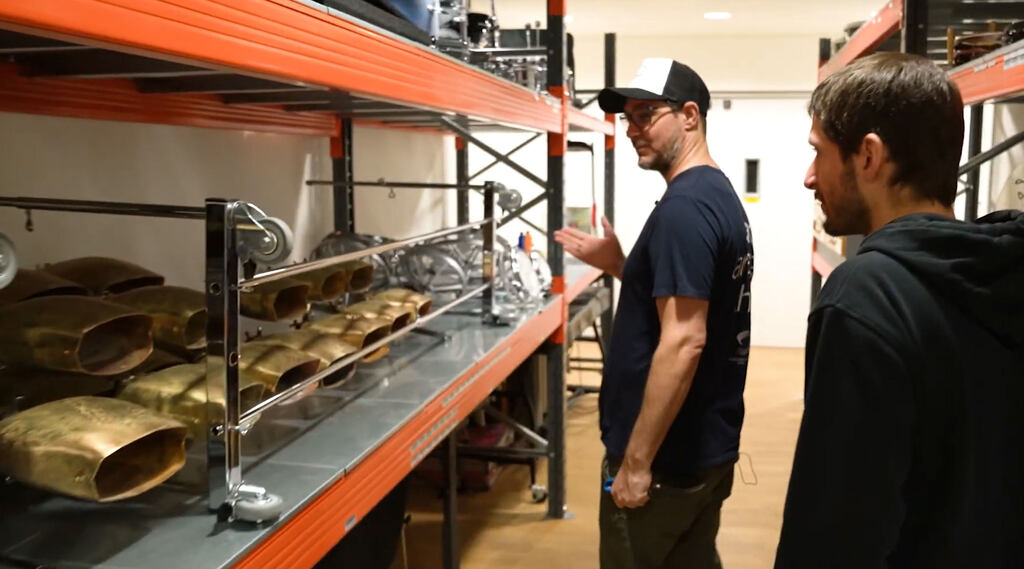
Around 200 percussion instruments
Below Stage A is a storage room with roughly 200 individual percussion instruments. Among them: three octaves of tuned cowbells. "If you want more cowbell, go for it," Bernd told me. Yes, the facility has an actual chromatic cowbell collection. Composers can browse the full instrument list on the Synchron Stage website and compose directly using sampled versions (recorded in Stage A) before the session begins. What they hear in pre-production is what they will get on the recording day.
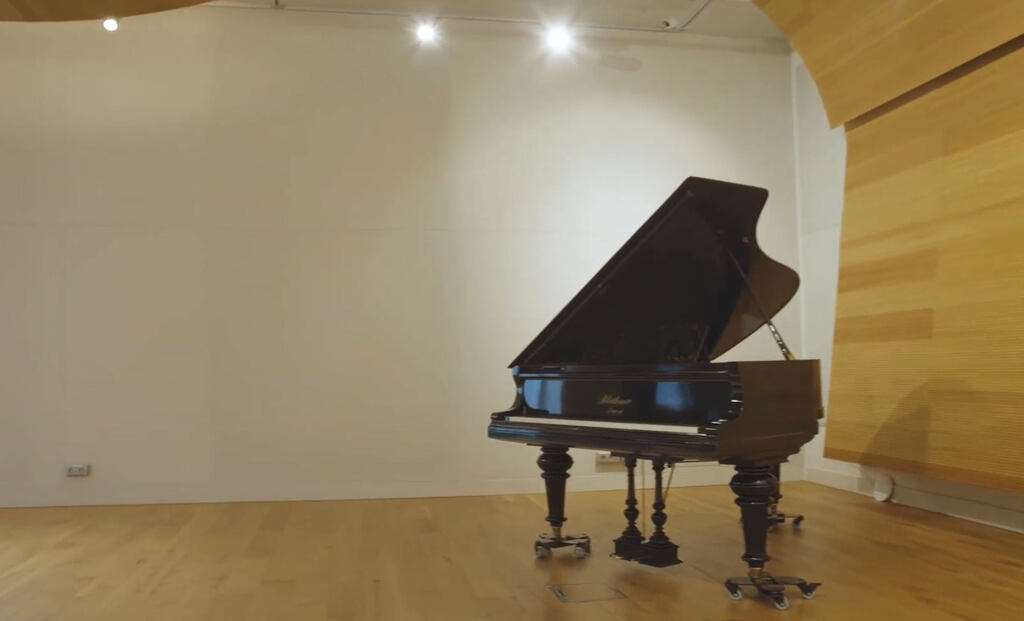
A climate-controlled piano storage
Concert grand pianos are sensitive to temperature and humidity - changes in either can pull the tuning out of specification in hours. The piano storage at Synchron Stage Vienna maintains the same climate as Stage A and is connected to it by elevator. Pianos are tuned downstairs, placed on wheeled platforms so they can be moved without anyone touching the instrument body directly, then brought up to Stage A without disrupting the tuning in transit.
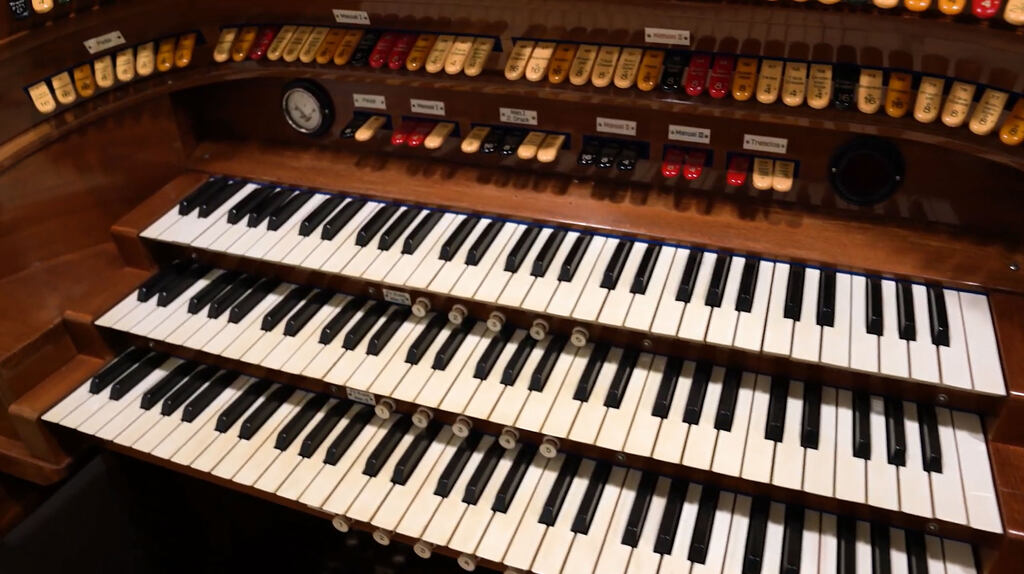
The cinema organ
One of the more unexpected discoveries: a cinema organ keyboard, stored in the building and used occasionally in Stage A. Its effect stops include labels like *Pferdegetrampel* (horse hooves), saxophone, and telephone ringing. Cinema organs in the original scoring stages were used to play very low-end notes that added sub-bass depth to the orchestra, there was no software VSTs to do that job at the time. That application is now handled with software instruments in modern productions, but the organ remains part of the facility's history.
If you want to find out how it sounds to mix music at Synchron Stage, our Space Replicator plugin lets you mix in their control rooms on your headphones. Both control rooms at Synchron Stage Vienna have been captured and built into the plugin, Vienna Synchron Stage Control A, with its farfield and midfield speaker system, and Vienna Synchron Stage Control B, with midfield speakers. Put on your headphones and you are mixing in the same rooms where the scores you just read about were played back.
Q: Where is Synchron Stage Vienna located?
Synchron Stage Vienna is in Vienna, Austria. The facility occupies a purpose-built building originally constructed in the 1940s for recording film scores with full orchestras.
Q: What films have been recorded at Synchron Stage Vienna?
The credits list is long. Among the better-known projects: Hans Zimmer's score for *Inferno* (2016), Rupert Gregson-Williams' music for *The Crown* (Netflix), Lorne Balfe's *Ad Astra* (2019), the BAFTA-nominated score for *Promising Young Woman* (2020), *Klaus* (2019), *Over the Moon* (2020), *Moonfall* (2022), and *American Fiction*, among many others. The full list is on Synchron Stage Vienna's projects page.
Q: What is the DECA tree microphone system?
The DECA tree is the main room microphone system at Synchron Stage Vienna, mounted above the conductor's position in Stage A. It consistent of 3 microphones mounted on a T bar to capture a center image and stereo left and right. In Bernd Mazagg's setup, it is supplemented by Outrigger microphones on either side for a wider orchestral image, and by high outriggers positioned near the ceiling for additional room ambience.
Q: What LEWITT microphones does Synchron Stage Vienna use?
Among the microphones Bernd Mazagg uses in Stage A are the LEWITT LCT 1040 (in the Outrigger positions, to widen the orchestral image) and the LEWITT LCT 540 S (valued for its 4 dB(A) self-noise in sessions where capturing the quietest orchestral passages cleanly is essential).
Q: How long does it take to record a film score at Synchron Stage Vienna?
It varies considerably by project. Some sessions take three days; others are part of a production that unfolds over a year and a half. The timeline depends on the scale of the score, the size of the ensemble required, and the complexity of the music.
Related stories
Inside Sound Factory: a tour of the iconic Hollywood recording studio
Sound Factory has been running sessions on Selma Avenue in Hollywood since the early 1960s. The Jackson 5 recorded "I Want You Back" here in 1969, Linda…
Inside Dark Horse Recording: the studio built for the artist
The drive to Dark Horse Recording takes you out of the bustling Nashville scene and into the Tennessee countryside. By the time you arrive, you understand why…
Inside Stella Sound studios with Justin Stanley
Justin Stanley and Rachel Eckroth take on Project 1040.

