
Blog
Blog
When you upgrade to studio headphones, one question comes up straight away: open-back vs. closed-back headphones. Which one should you get?
In this blog, you can learn
As always, this post was written by a human and checked by LEWITT’s audio engineers.

Open-back headphones have an opening in the ear cup. Sound escapes easily outside, and you can also hear outside sounds.
Closed-back headphones seal your ears and therefore create isolation from the outside.
Sounds simple, but the two designs affect your work in ways you would not expect.
Let's take a closer look.

Closed-back headphones are sealed and trap air and sound waves inside the ear cup. Sound is delivered straight to your ears, something you experience with earbuds as well. With an open-back design, air and sound escape through the opening, leading to a more spacious soundstage.
But do they ultimately sound different?
To answer this, I talked to Konstantin Davy, an acoustic engineer in the LEWITT R&D department who has spent years on headphone design.
“A closed-back headphone inherently has a higher stiffness in its acoustic system, because the air trapped in the back volume acts as a spring. Engineers call this higher acoustic impedance, not to be confused with electrical impedance. It means the sound of a closed-back headphone depends much more drastically on how well it seals against your head than an open-back does, especially in the bass. With open-backs this is much less of an issue, because their acoustic impedance is lower."
In practice: if you wear glasses, have long hair, a beard, or a particular jawline, the seal changes, and so does the sound of a closed-back headphone.
"Other than bass, there is not much between the average closed-back and the average open-back headphone."
Bass aside, there is no inherent open-back or closed-back sound. It comes down to the tuning and the seal.
Tuning a closed-back so it holds up on every head is the harder problem, and it is the one we set out to solve with our own studio headphones. The LEWITT LW6 gives you the transparent, natural sound you'd usually associate with open-back designs in a closed-back design, adding the advantage of effective sound isolation.
 Closed-back headphones are the best choice for recording and tracking
The effective passive isolation makes closed-back headphones the right choice if you are recording with a microphone and your headphones are anywhere near it. A vocal take with bleed from your headphones in it is much harder to mix.
If you are recording in a loud or live setting, the better sound seal helps you hear more accurately what you want to focus on.
The effective passive isolation of closed-back designs leaves you undisturbed by outside sound, and you don’t disturb people around you.
If you are only going to buy one pair for your whole audio production workflow, get closed-backs. They are more versatile, as you can track with them, mix and master with them, work on the go, and listen to music on the train with them.
When it is hot, long sessions in closed-back headphones can get sweaty. No fresh air reaches your ears, and that becomes uncomfortable after a while.
Glasses, long hair, a beard, or the shape of your head can all change the sound as they alter the seal. Meaning that there is always the chance that a closed-back headphone that sounds great to somebody else might sound off to you.
With closed-back headphones, you hear your own voice inside your head, which some people find distracting. You have probably seen singers wearing only one ear cup during a take, which is one way around it.
Open-back headphones are usually described as having a wider soundstage, meaning the sense of space and placement around you feels more natural, especially if your reference is listening on speakers.
Since there is no sealed chamber, the sound does not sit inside your head as much, and hence feels more "open".
Open-back headphones are often more comfy, and your ears also stay cooler.
Open-back headphones are often described as "transparent sounding", but as we mentioned, that is more due to the tuning and not specific to the "open" design.
It's also worth mentioning that there are virtual monitoring plugins available these days. On the one hand, they can compensate for your headphones' frequency response and can make it sound more "neutral" by using compensation profiles. On the other hand, these plugins can give you the impression of sitting in front of real speakers in an acoustically treated mixing room, making the stereo image even more natural.
Space Replicator is such a plugin and is available as a free version here.
The pros and cons are heavily intertwined.
As they are not effectively sealed, people (or microphones) hear what you hear, and you hear your surroundings far more clearly than you would with closed-back headphones.
Bass is harder to engineer. An open design has no defined back volume to tune against, so getting deep, extended low end out of one takes more work than it does with closed-back headphones.
Yes, absolutely. Andrew Scheps, who mixed Adele, Red Hot Chili Peppers, and more, is famous for doing the bulk of his mixing on headphones.
The real reason open-backs have the reputation of being better for mixing comes from the fact that open-back designs are less complicated to tune.
But to mix well, you need a listening environment you can trust. You need enough detail to make good decisions, and an honest picture of what you have. If your closed-back headphones give you that, you can make great mixes on them.
"Honest" has a specific meaning. Konstantin puts it like this: a mixing headphone should reproduce sound the same way an instrument sounds in real life. Nothing added, nothing taken away. If that makes the instrument sound bad, the problem is your mix or your mic placement, and that is exactly what you want the headphone to show you.
A headphone with an exciting sound hides those problems, but a neutral one shows them to you more clearly.
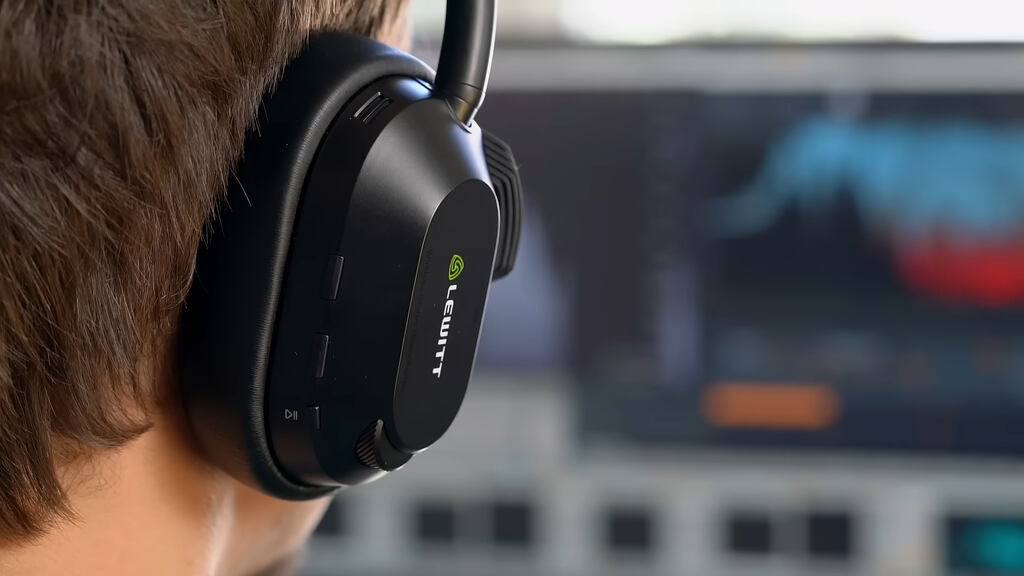
You can make great sounding mixes on closed-back headphones.
We recently built a closed-back headphone with the transparency open-back designs are commonly associated with: the LEWITT LW6. We tuned it exactly the way we wanted, and measured not on a measuring dummy alone, but on the heads of real people.
The result is a closed-back headphone you can trust for the most detailed decisions in a mix. You can read more about how we tuned and developed it in LEWITT tuning for LW6 Wireless Studio Headphones.
If you have read this far, you already have what you need to decide. But I also asked Konstantin what he would tell a friend buying one pair for everything:
"With the advent of headphone EQ and other tools, the most important thing for a headphone for studio use isn't the sound. It's how comfortable the headphones are to wear. The best-sounding headphones won't help you a lot if you find yourself wanting to cut the recording session short just to get out of the headphones."
After comfort, he names two things. It has to be closed, so your monitoring is not audible on the microphone. And it has to be reliable: as little variation as possible from one person's head to the next.
Here is the tl;dr version.
If you only want one pair for everything, get closed-back headphones. You should never track or record vocals with open-back ones when a microphone is involved.
If you are in a quiet room by yourself and you mostly mix, open-back headphones are a great choice. The LW6 is just as strong an option here. It was tuned to be trusted for detailed mixing decisions, and it still gives you isolation on the days you need it.
We have talked a lot about headphones, but they still have some downsides compared to a speaker setup. The sound feels like it's inside your head. Judging the stereo field is tricky, and more.
You can change all of that with Space Replicator. This powerful plugin lets you experience real spaces on your headphones as if you were there - be it a million-dollar mixing studio or a car. Perfect for mixing and mix translation checks.
A few myths about headphones come up again and again, so we asked our audio engineers to settle them. Every answer below was double-checked by audio engineers.
False. Sealing the back of an ear cup traps the air behind the driver, and that air acts like a spring. The added stiffness raises the system resonance and cuts low-frequency output. A closed-back design has to work to get its bass back.
The initial belief comes from measurement. Headphones are measured on dummy heads, whose flat cheeks let the ear pads seal almost perfectly. Real heads don’t, and closed-backs depend on that seal far more than open-back headphones do. So they measure more bass on the rig than they deliver on your head.
That doesn’t make closed-backs worse at bass. A tuned vent in the back volume can relieve the stiffness and buy the extension back, sometimes with a boost on top. Open-back headphones have no back volume to tune against at all, which makes deep, extended bass harder to engineer into them.
Bass comes down to how the headphone is engineered, not whether the back is open or closed.
Not true. Accuracy is a tuning decision. A badly tuned open-back headphone can be less accurate than a well-tuned closed-back one.
There is no reliable evidence for this. Konstantin: "There are no reliable studies indicating that open or closed headphones behave differently in terms of listening fatigue in a manner that is independent of session length and accumulated level."
What causes listening fatigue is well established: how loud you monitor, and how long you go without a break.
Comfort is a separate question, and there the open design has a real advantage. Your ears stay cooler, and the pressure on your head is lower, which matters on a six-hour session. But being more comfortable to wear is not the same as being less tiring to listen to.
If you want to work longer, turn it down and take breaks. That works on either design.
False. Price alone tells you very little about how a headphone sounds. While developing the LW6 studio headphones, we ran many blind listening tests. The subjects never touched the headphones; somebody else put them on their head, so they judged the sound and nothing else. Over and over, price turned out to be a poor predictor of how accurate and how well-liked a headphone was.
False. Badly tuned headphones sound boxy. A well-tuned closed-back headphone does not sound boxy at all. Pay attention to the tuning, not to whether the ear cup is open or closed.
Not necessarily. This comes down to tuning again. Some open-back headphones sound more detailed than some closed-back ones, but the design on its own is not a good indicator of clarity or detail.
Related stories

LEWITT tuning for LW6 Wireless Studio Headphones
Designing headphones that sound natural is a challenge in itself, even more so when they feature a closed-back design. In this blog, you can learn about the…

Better mixes for free with LEWITT Space Replicator.
LEWITT's Space Replicator is a virtual monitoring plugin for mixing and mix translation checks on your headphones. And now there is a completely free version…

Mixing on headphones
To make great mixes, you need to hear your music accurately and in detail across the frequency spectrum. Without a well-tuned, acoustically treated studio, this…



.jpeg)